Welcome to Our Group
Our research focuses on multimodal spatial intelligence, structural and compositional understanding of scenes, and the application of these techniques to remote sensing interpretation and underwater environment understanding. These involve techniques like:
- MLLM-assisted Spatial Reasoning, e.g., Object-goal Navigation, Visual-language Navigation, Multimodal Reasoning.
- Scene Graph Generation, e.g., Remote Sensing / Under-water Scene Graph Generation.
- Change Detection, Semantic Segmentation, and Instance Segmentation.

Dr. Wenbin Wang
Wenbin Wang obtained his Ph.D. degree in the VIPL group (VIPL-VSU) of the Key Lab. of Intelligent Information Processing (IIP) at Institute of Computing Technology (ICT), Chinese Academy of Sciences (CAS), advised by Prof. Xilin Chen and Prof. Ruiping Wang. Before this, he received his B.Eng. degree in Computer Science and Technology from Nankai University (NKU, 2013-2017). He was awarded the Nomination Award of the Doctoral Dissertation Incentive Program, China Society of Image and Graphics. He is the Chutian Scholar Talent Program of Hubei Province. He is an invited journal reviewer for IEEE TPAMI / IEEE TMM / PR / ESWA, and the invited conference reviewer for CVPR / ICCV / ECCV / NeurIPS. He is a member of the CAAI (Intelligent Service Professional Committee), CCF, and CSIG.

🔥 News
- 2026.08: A paper on remote sensing scene graph generation is accepted by IEEE TGRS.
- 2026.08: A paper is accepted by IEEE JSTARS.
- 2026.07: A paper is accepted by IEEE TGRS.
- 2026.05: A paper is accepted by IEEE TGRS.
- 2025.12: One paper is accepted by IEEE TCSVT.
- 2024.12: One paper is accepted by The Visual Computer.
- 2023.05: One paper on hierarchical SGG (SGoI) is accepted by IJCV.
- 2022.07: One paper is accepted by SCIENTIA SINICA Informationis.
- 2021.07: One paper on SGG and image captioning is accepted by ICCV 2021.
- 2020.07: One paper on hierarchical scene graph generation is accepted by ECCV 2020.
- 2019.03: One paper on visual relationship detection is accepted by CVPR 2019.
📝 Publications
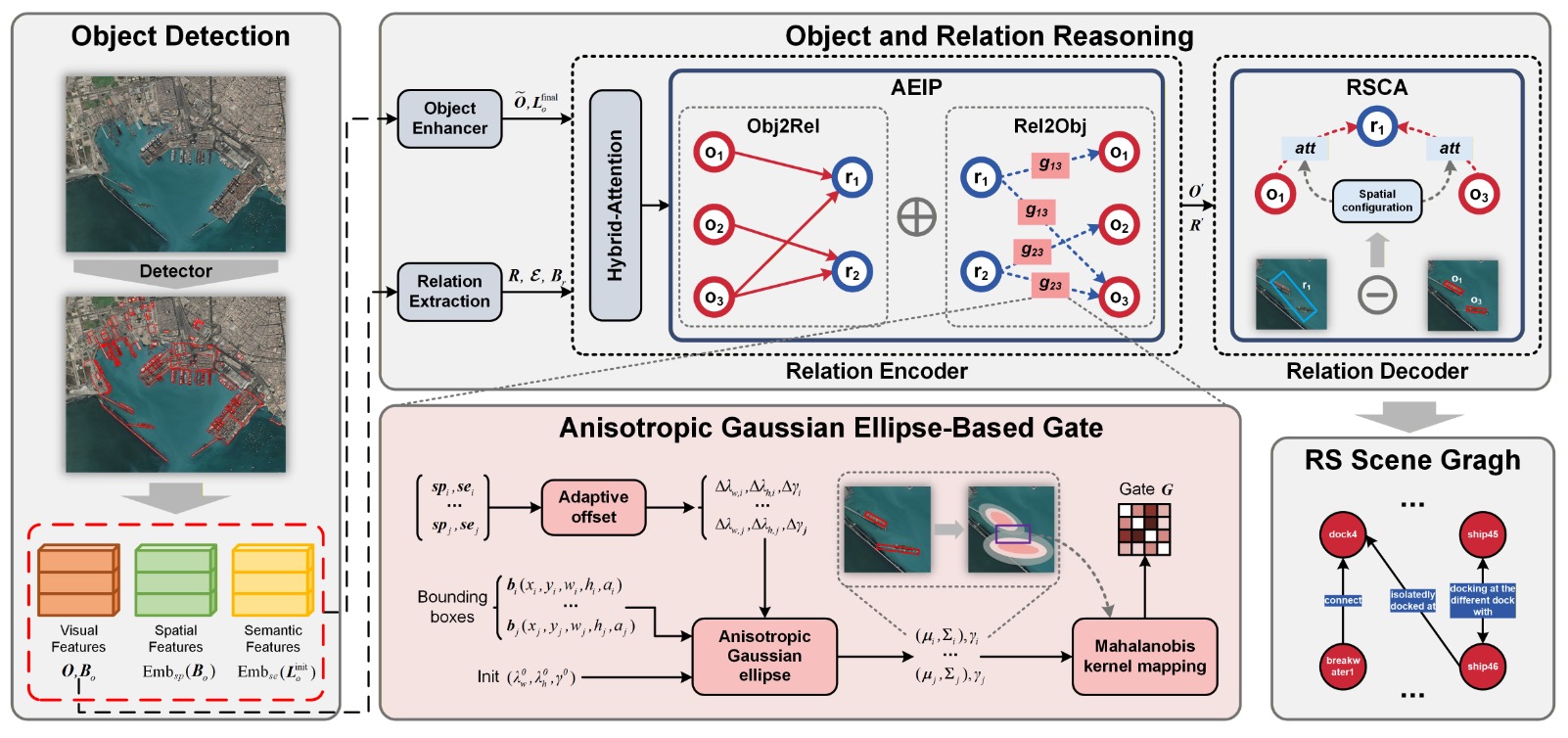
Spatially Anisotropic Reasoning Network for Remote Sensing Scene Graph Generation
Wenbin Wang, Yiheng Chen, Hang Sun, Dong Ren, Yansheng Li
- Remote sensing images contain multiple functional subscenes, while relation semantics are strongly shaped by objects’ relative spatial configurations.
- SARNet introduces Anisotropic Ellipse Influence Propagation (AEIP) to model object-centered spatial influence and suppress noisy long-range interactions, together with Relative Spatial Configuration Attention (RSCA) to enhance geometry-discriminative relation representations.
- CODE release: SARNet


Importance First: Generating Scene Graph of Human Interest
Wenbin Wang, Ruiping Wang, Shiguang Shan, Xilin Chen
- There exists a hierarchical preference about human perception when they analyze a natural scene.
- SGoI (Scene Graph of Human Interest) generation framework is proposed to present the scene graph according to the content importance.
- CODE release: TGIR


Topic Scene Graph Generation by Attention Distillation from Caption
Wenbin Wang, Ruiping Wang, Xilin Chen
- Scene graph generation and image captioning can be viewed as two forms of scene understanding.
- A shared framework that jointly generates scene graph and image caption is proposed in this work.
- CODE release: MMSceneGraph
: an SGG toolkit based on MMdetection, including most SOTA SGG methods.
TGRS 2026Wenbin Wang, Yiheng Chen, Hang Sun, Dong Ren, and Yansheng Li. Spatially Anisotropic Reasoning Network for Remote Sensing Scene Graph Generation. IEEE TGRS, vol. 64, Art. No. 4416521, 2026.JSTARS 2026Lu Wang, Chenxu Lou, Jing Wang, Junbo Yu, Lihua Zhao, Wenbin Wang, and Dong Ren. Scale-aware Fusion and Spatial-Frequency Collaborative Network for Remote Sensing Imagery Semantic Segmentation. IEEE JSTARS, vol. 19, pp. 28361-28378, 2026.TGRS 2026Hang Sun, Guanbo Feng, Bo Du, Yibing Zhan, Dong Ren, Wenbin Wang *, and Jun Wan. Heterogeneous Prompting Cross-Domain Modulation Network for Remote Sensing Image Dehazing. IEEE TGRS, vol. 64, Art. No. 5631618, 2026.TGRS 2026Hang Sun, Runzhou Li, Chenyang Wang, Lefei Zhang, Dong Ren, and Wenbin Wang *. Frequency-Domain Heterogeneous Rank-Entropy Bipolarization Network for Remote Sensing Change Detection. IEEE TGRS, vol. 64, Art. No. 5621517, 2026.JSTAR 2025Lu Wang, Chenyang Wang, Runzhou Li, Junbo Yu, Hang Sun, Wenbin Wang *, and Dong Ren. MDFANet: Multidimensional Feature Alignment Network for Self-Supervised Pretraining in Remote Sensing Change Detection. IEEE JSTAR, vol. 19, pp. 2355-2372, 2025.TCSVT 2025Hang Sun, Qingfei Zhong, Bo Du, Zhigang Tu, Jun Wan, Wenbin Wang *, Dong Ren. Bidirectional-Modulation Frequency-Heterogeneous Network for Remote Sensing Image Dehazing. IEEE TCSVT, vol. 35, no. 11, pp. 10649-10664, 2025.TVC 2025Tang Xu, Wenbin Wang *, ALin Zhong. HOIEdit: Human-Object Interaction Editing with Text-to-Image Diffusion Model. The Visual Computer, vol. 41, pp. 6187-6199, 2025.ECCV 2024Yansheng Li, Tingzhu Wang, Kang Wu, Linlin Wang, Xin Guo, Wenbin Wang. Fine-Grained Scene Graph Generation via Sample-Level Bias Prediction. In ECCV, vol. 15084, pp. 18-35, 2024.[pdf] [DOI] [arXiv] [supp]
TPAMI 2024Yansheng Li, Linlin Wang, Tingzhu Wang, Xue Yang, Junwei Luo, Qi Wang, Youming Deng, Wenbin Wang et al. STAR: A First-Ever Dataset and A Large-Scale Benchmark for Scene Graph Generation in Large-Size Satellite Imagery. TPAMI, vol. 47, no. 3, pp. 1832-1849, 2024.[project]
IJCV 2023Wenbin Wang, Ruiping Wang, Shiguang Shan, Xilin Chen. Importance First: Generating Scene Graph of Human Interest. IJCV, vol. 131, no. 10, pp. 2489–2515, 2023.SCIENTIA SINICA Informationis 2022Wenbin Wang, Ruiping Wang, Xilin Chen. Balanced Scene Graph Generation Assisted by Additional Biased Predictor. Scientia Sinica Informationis, vol. 52, no. 11, pp. 2075-2092, 2022.[pdf]
ICCV 2021Wenbin Wang, Ruiping Wang, Xilin Chen. Topic Scene Graph Generation by Attention Distillation from Caption. In ICCV, pp. 15900-15910, 2021.[DOI] [pdf]
ECCV 2020Wenbin Wang, Ruiping Wang, Shiguang Shan, Xilin Chen. Sketching Image Gist: Human-Mimetic Hierarchical Scene Graph Generation. In ECCV, vol. 12358, pp. 222–239, 2020.[pdf] [data] [slides] [video] [arXiv] [proc.] [supp]
CVPR 2019Wenbin Wang, Ruiping Wang, Shiguang Shan, Xilin Chen. Exploring Context and Visual Pattern of Relationship for Scene Graph Generation. In CVPR, pp. 8188–8197, Long Beach, CA, US, 2019.[DOI] [pdf] [proc.]
